





No payment required for items priced at $0.
Continue to secure checkout and place orders for free. No shipping fees or hidden charges.
Your order will be reviewed. We will contact you promptly for delivery and payment options at your convenience.
Castello Banfi
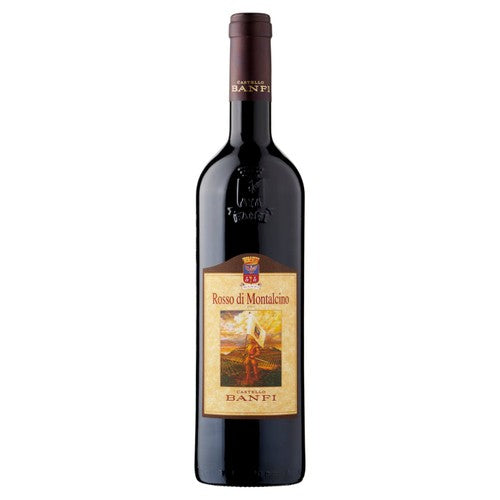
Banfi Rosso di Montalcino
Banfi Rosso di Montalcino
Regular price
£27.98 GBP
Regular price
£31.50 GBP
Sale price
£27.98 GBP
Taxes included.
Shipping calculated at checkout.
Quantity
Couldn't load pickup availability
Red Wine – 100% Sangiovese
Tuscany (Montalcino) – Italy
A classic Tuscan red often described as "Baby Brunello," offering the structure of Montalcino with immediate approachability.
Please drink responsibly: The UK Chief Medical Officers recommend adults do not regularly drink more than 14 units per week
Glass Bottle
Glass bottle, fully recyclable
Contains Sulphur Dioxide/Sulphites
Contains Sulphites
Castello Banfi
Castello Banfi is a family-owned vineyard estate and winery in the Brunello region of Tuscany. They were instrumental in cloning research for the Sangiovese grape and are leaders in sustainability within the region. Their holistic approach combines deep respect for tradition with state-of-the-art winemaking facilities, producing wines that are globally recognised for quality and consistency.
Castello Banfi
Hallgarten Wines
Sangiovese
2023
Often described as the "Baby Brunello," Rosso di Montalcino offers a fresher, more accessible entry point to one of Italy's most prestigious wine zones. Produced from 100% Sangiovese in the hills of Tuscany, this DOC allows producers to release younger wines that showcase bright fruit and approachability without the mandatory long aging required for its famous big brother, Brunello.
Intense ruby red in colour, with a bouquet of blackberries, plums, and raspberries, mingled with hints of violet and liquorice. The palate is well-structured yet soft, with supple tannins and a lingering finish that highlights the characteristic fresh acidity of Sangiovese.
14
10.9
Castello Banfi
Dr. Mateo Bagnoli
Grapes are fermented in hybrid stainless steel and wood tanks (Horizon) with maceration on the skins for 7–10 days. The wine is then aged for approximately 10–12 months, split between French oak barriques and large Slavonian oak casks. This aging regimen adds complexity without overpowering the fruit, followed by an additional 6 months of bottle aging before release.
-

Eastbrook Village: A Fresh Perspective on Milto...
Explore Eastbrook Village in Milton Keynes, where one- to five-bedroom homes meet an ambitious vision for green space, connectivity and community living. Advertised prices start from £260,000, subject to availability.
Eastbrook Village: A Fresh Perspective on Milto...
Explore Eastbrook Village in Milton Keynes, where one- to five-bedroom homes meet an ambitious vision for green space, connectivity and community living. Advertised prices start from £260,000, subject to availability.
-

Mortgage Loans & Financial Services – Our Partn...
Interactive Group has partnered with Lifetime Capital UK to offer our customers expert mortgage advice, insurance, protection, and equity release — with a specialist focus on helping international buyers purchase...
Mortgage Loans & Financial Services – Our Partn...
Interactive Group has partnered with Lifetime Capital UK to offer our customers expert mortgage advice, insurance, protection, and equity release — with a specialist focus on helping international buyers purchase...
-

Lombard Square — A New Chapter for Plumstead, R...
Lombard Square is Berkeley Group's landmark 17-acre regeneration development in Plumstead, South-East London — delivering nearly 2,000 luxury homes, a central park, and world-class amenities in the Royal Borough of...
Lombard Square — A New Chapter for Plumstead, R...
Lombard Square is Berkeley Group's landmark 17-acre regeneration development in Plumstead, South-East London — delivering nearly 2,000 luxury homes, a central park, and world-class amenities in the Royal Borough of...


