





No payment required for items priced at $0.
Continue to secure checkout and place orders for free. No shipping fees or hidden charges.
Your order will be reviewed. We will contact you promptly for delivery and payment options at your convenience.
Stryker
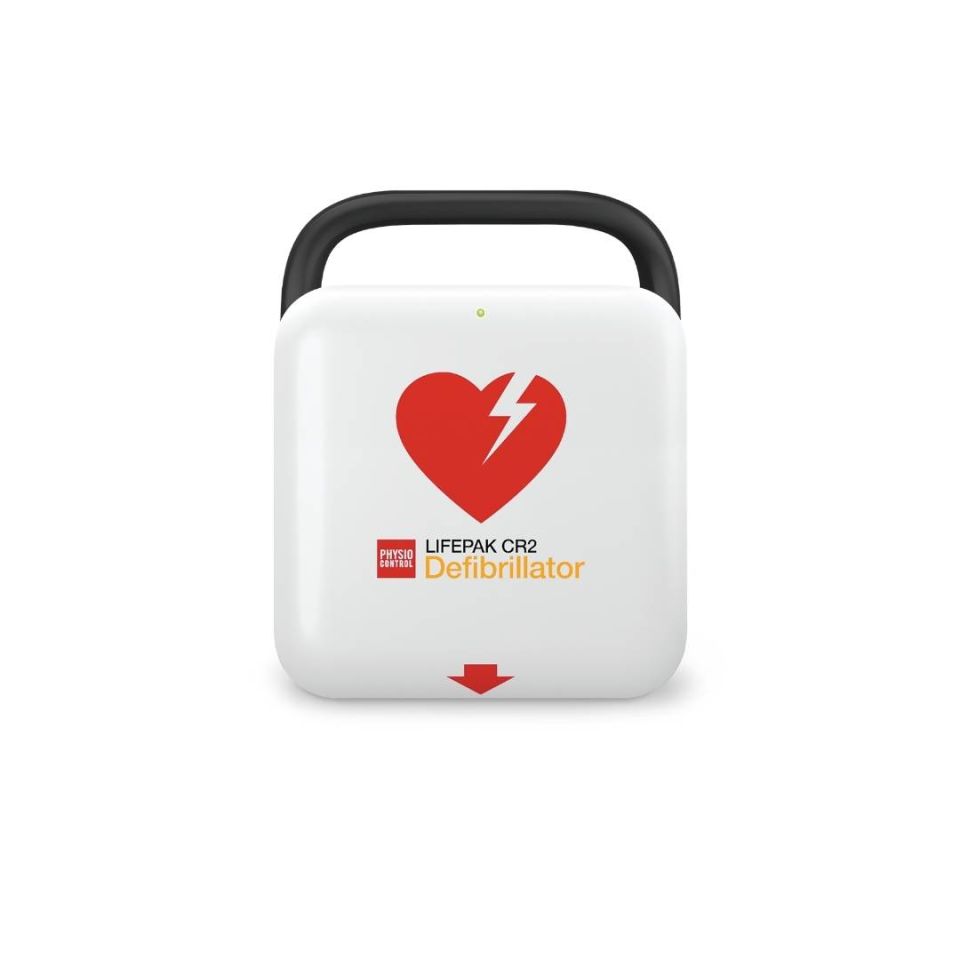
Lifepak CR2 Fully - Automatic Defibrillator with USB
Lifepak CR2 Fully - Automatic Defibrillator with USB
Regular price
£1,443.00 GBP
Regular price
Sale price
£1,443.00 GBP
Taxes included.
Shipping calculated at checkout.
Quantity
Couldn't load pickup availability
For organisations that want the simplest possible emergency response, the fully automatic LIFEPAK CR2 removes the final decision from the equation. Once the pads are placed, this defibrillator machine analyses the heart rhythm and delivers the shock itself, no button press required. The responder’s only job is to follow the voice prompts and perform CPR when instructed.
Manufactured by Stryker (formerly Physio-Control), the CR2 Fully Automatic with USB is designed for environments where most potential responders have no formal first aid training. It provides the same escalating energy protocol, CPR coaching, and ClearVoice adaptive audio as the semi-automatic model, with one critical difference: the device takes the shock decision entirely out of the responder’s hands.
The LIFEPAK CR2 is the direct replacement for the now discontinued LIFEPAK CR Plus range. If your organisation previously used a CR Plus and is looking for an upgrade, the CR2 delivers significant improvements in speed, guidance, and durability while maintaining the same trusted Physio-Control pedigree.
The Physio-Control LIFEPAK CR2 defibrillator (also known as the LP CR2 or Stryker CR2) is one of the most widely specified AED defibrillator machines in UK public access and workplace settings.
For more information on this defibrillator, or to find out about how we can combine this device into a money-saving package deal for you, please contact one of our Defib Experts using the web chat, or give us a call on: 01298 872 186
Authorised Stryker Distributor • 10-Year Warranty • UKCA & UK MDR Compliant • Free Reminder Service • Next-Day UK Delivery*
*Orders before 12 pm, subject to stock.
Key Features of the CR2 (USB version)
Voice-guided from start to finish
Open the lid, and the CR2 walks you through every step with spoken instructions. ClearVoice technology monitors background noise and raises the volume automatically, essential in echoing hallways, busy reception areas, or open-plan offices.
CPR coaching that keeps you on track
Between shocks, the built-in metronome sets the correct compression pace. Spoken prompts guide hand placement, compression depth, and timing. If compressions stop, the device tells you to resume. No guesswork, no prior knowledge needed.
Escalating energy up to 360J
Shocks are delivered at 200J, 300J, and 360J in sequence. The device manages the escalation automatically, applying greater energy if earlier shocks are insufficient. Paediatric shocks follow a separate protocol at 50J, 75J, and 90J.
Single pads for all patients
The QUIK-STEP electrodes peel straight from the base of the device and work for adults and children alike. Press the Child Mode button to switch energy levels and CPR guidance for patients aged 1–8 or under 25kg. No spare paediatric pads to source or store.
USB data retrieval
After an incident, event data, ECG recordings, shock delivery logs, and responder activity can be downloaded to a computer via the included USB cable. This information is routinely requested by ambulance services and supports internal incident records. The USB model provides this without the cost of a Wi-Fi or cellular subscription.
Always checking itself
Automatic self-tests run daily, weekly, and monthly. A green LED flashes every six seconds to confirm readiness. When something needs attention, the indicator changes, giving you time to act before an emergency tests the device.
Rugged and portable
IP55-rated against dust and water. MIL-STD-810G tested for shock and vibration. Just 2 kg. The white casing with red heart logo is designed to be immediately recognisable in any setting.
Technical Specifications
| Manufacturer | Stryker (formerly Physio-Control) |
|---|---|
| Model | LIFEPAK CR2 Semi-Automatic — USB (LP CR2) |
| Operation | Semi-automatic (user-initiated shock) |
| Connectivity | USB (micro-USB for data transfer) |
| Waveform | Biphasic Truncated Exponential with impedance compensation |
| Adult Energy | 200J / 300J / 360J (escalating, configurable 150–360J) |
| Paediatric Energy | 50J / 75J / 90J (via Child Mode button) |
| Time to Shock (semi-auto) | < 17 seconds after pads applied |
| First Shock Charge Time | 0 seconds (pre-charged) |
| ECG Analysis | Shock Advisory System™ |
| CPR Feedback | Metronome, rate/depth guidance, hand placement prompts |
| Voice Prompts | ClearVoice™ adaptive volume |
| Electrode Pads | QUIK-STEP™ dual adult/child (up to 4-year shelf life) |
| Battery | Li/MnO₂, 12.0V, 4.7Ah — 166 shocks at 200J or 800 min operating time |
| Battery Standby Life | Up to 4 years. At least 6 shocks remain at first replace indicator. |
| Self-Testing | Daily, weekly, monthly automatic checks |
| Readiness Indicator | Green LED flashing every 6 seconds |
| IP Rating | IP55 (dust-protected, water-jet resistant) |
| Weight | 2.0 kg (with battery and pads) |
| Dimensions | 9.7 × 22.6 × 27.4 cm (H × W × D) |
| Operating Temp | 0°C to 50°C |
| Storage Temp | -30°C to 60°C (long-term: 15°C to 35°C) |
| ECG Storage | Min 60 min across 2 patient episodes (flash RAM) |
| Patient Impedance | 10–300 ohms |
| Humidity | 5–95% non-condensing |
| Safety Standard | IEC 60601-1 / EN 60601-1 |
| Shock/Vibration | IEC 60068-2-27 (40g, 11ms) / MIL-STD-810G |
| Compliance | UKCA, UK MDR, FDA cleared |
| Warranty | 10 years (Defibstore) | 8 years (manufacturer standard) |
Where the CR2 is Used
We supply the fully automatic CR2 USB to organisations across the UK, from community centres and parish councils to high-traffic sites. The LIFEPAK CR2 is trusted in environments including major airports such as Heathrow, where devices are on standby as part of emergency response provision.
We also work with the Oliver King Foundation, whose founder Mark King OBE campaigned for over a decade to place defibrillators in every state-funded school in England, a programme that delivered over 20,000 devices and has already saved lives. Their advocacy for accessible, easy-to-use AEDs reflects exactly why the fully automatic model exists.
The fully automatic configuration is chosen most often by organisations where untrained members of the public are the most likely first responders: community defibrillator schemes, reception areas, village halls, leisure facilities, and schools where staff turnover means training cannot be guaranteed.
-

Mortgage Loans & Financial Services – Our Partn...
Interactive Group has partnered with Lifetime Capital UK to offer our customers expert mortgage advice, insurance, protection, and equity release — with a specialist focus on helping international buyers purchase...
Mortgage Loans & Financial Services – Our Partn...
Interactive Group has partnered with Lifetime Capital UK to offer our customers expert mortgage advice, insurance, protection, and equity release — with a specialist focus on helping international buyers purchase...
-

Lombard Square — A New Chapter for Plumstead, R...
Lombard Square is Berkeley Group's landmark 17-acre regeneration development in Plumstead, South-East London — delivering nearly 2,000 luxury homes, a central park, and world-class amenities in the Royal Borough of...
Lombard Square — A New Chapter for Plumstead, R...
Lombard Square is Berkeley Group's landmark 17-acre regeneration development in Plumstead, South-East London — delivering nearly 2,000 luxury homes, a central park, and world-class amenities in the Royal Borough of...
-

UAE Real Estate 2026: The World's Most Exciting...
Explore the UAE real estate market in 2026 — from Dubai's record-breaking luxury launches to Abu Dhabi's cultural masterplans, discover why the Emirates remains the world's most compelling property destination.
UAE Real Estate 2026: The World's Most Exciting...
Explore the UAE real estate market in 2026 — from Dubai's record-breaking luxury launches to Abu Dhabi's cultural masterplans, discover why the Emirates remains the world's most compelling property destination.


